
Clarity Coaching — JMSS Interview Intensive 2026

Nine hours on how
to sound like
yourself in an
interview.

Three nights, live on Zoom, for students who have received a JMSS interview invitation. The work is structure, clarity, and composure — building answers out of your own material rather than borrowing someone else's. There is no script here and no predicted question list.

Session 1Friday 7 August · 6:00–9:00 pm AESTZoom
Session 2Saturday 8 August · 4:00–7:00 pm AESTZoom
Session 3Sunday 9 August · 9:00 am–12:00 pm AESTZoom
Live on Zoom — join from anywhere
Every session recorded — kept until interview day
Q&A in every session — no camera needed
One payment, GST included. Enrolment closes when the final session begins.
Breaks built into each night
No camera needed
Nothing drip-released
Recordings kept until interview day
Read this first
We do not have the JMSS interview rubric. Nobody outside the school does.
The format has shifted between years. Anyone offering the exact questions is guessing. What's taught here is the capability underneath, and the difference matters enough to say before anything else.
There is a free version
Much of this material is already on the YouTube channel at no cost.
If your family works through it properly, that may well be enough. There's a full section below on exactly what this weekend adds and what it doesn't.
Who it's for
Students invited to a JMSS interview who want to build their own answers rather than memorise a model one. This is a large-format Zoom session, so individual attention isn't guaranteed. If your child is after a script or one-to-one coaching, this is the wrong room.
The limits, stated up front

What we don't know
about the JMSS
interview.

JMSS does not publish its interview rubric. It does not release the structure in advance, and it has not run the same format every year. Accounts from past cohorts describe different combinations of individual conversation, group activity, and written survey depending on the year and the entry level.

There is no leaked question list here and no answers tuned to a marking scheme nobody outside the school has seen. If that's what you're after, it isn't in this room.

Unknown

The rubric, the weighting, and this year's exact structure

How the panel scores, how many stages there are, whether the format matches any previous year — none of it is public. Any program claiming otherwise is either guessing or assuming you won't check.

Known failure mode

Rehearsed answers break under the smallest rephrasing

A memorised answer collapses the moment the question is worded differently, and experienced educators are very good at hearing when a fifteen-year-old is reciting. Scripting isn't just fragile — it costs marks in every interview context there's evidence for.

Known and stable

The underlying skills hold regardless of format

Whatever the structure, a small group of adults will form an impression through a short conversation. Structuring a thought under pressure, handling a question you can't answer, talking about something you've actually done — those transfer across every version of the format.

The obvious question

Much of this is already
on YouTube, for free.

That's true, and it isn't a teaser. The interview material on the channel is detailed and complete, put there because the gap needed filling regardless of who profits from it. A family that works through it carefully will be better prepared than most students who walk in cold. Some of you should do exactly that and pay nothing.

What the free version does

Frameworks, explained properly, at your own pace

The concepts, the reasoning behind them, and worked examples. Same thinking, no cost, no expiry. If your child is self-directed and your family has time to work through it together, that route is genuinely open and nobody here will pretend otherwise.
What it can't do

Respond to your child, in the moment, in front of others

A video can't look at their achievement list and tell them which parts are worth talking about. It can't tell them an answer sounded recited. And it can't put them in a room where other students are being corrected in real time, which is where a lot of the learning actually happens.

Why there's a price at all

The cost is doing part of the work

A paid cohort filters. Students who commit to a room at 6 pm on a Friday are, on the whole, the ones who intend to do the work between sessions and build something of their own out of it.

That matters because of what's being taught. The method is about finding your own way of answering — and a room full of people hunting for a model answer to copy makes that harder for everyone in it.

Put plainly: if your child wants a set of answers to memorise, the free videos will serve them better and cost nothing — and there are no hard feelings in that. This weekend is for students who'd rather work out what they actually think and learn how to say it clearly. It's a narrower group on purpose.

The three nights

Nine hours built as a
progression — not three
separate talks.

Friday builds the raw material: what your child has actually done, and which parts are worth talking about. Saturday turns that into delivery. Sunday puts it under pressure and ends with a plan for the days before the interview. The work between nights is where most of the change happens.

Session One
Friday 7 August · 6:00–9:00 pm · breaks included

The raw material

Before delivery, content. Most students arrive with a list of certificates and no sense of which parts of their own life are worth discussing.

  • What a selection panel is assessing — and what it isn't
  • How to build an achievement inventory, and how to cut it back down
  • How to judge which of your own experiences will actually hold a conversation
  • How to talk about a genuine interest without sounding rehearsed
  • How to write about yourself: CVs, forms, and pre-interview surveys
Between sessions: work on your own list. Bring it back Saturday.
Session Two
Saturday 8 August · 4:00–7:00 pm · breaks included

Communication and distinctness

The same material delivered two different ways produces two different outcomes. This night is about the delivery.

  • How to structure an answer in real time, without a script
  • How to reason out loud so a panel can follow your thinking
  • What to do when you're asked something you can't answer
  • How voice, pace, and pausing change the way an answer lands
  • What actually makes a candidate memorable when the panel has heard forty
  • Live answer breakdowns with students in the room
Between sessions: record yourself, then watch it back. Uncomfortable, and the fastest twenty minutes of the weekend.
Session Three
Sunday 9 August · 9:00 am–12:00 pm · breaks included

Pressure, psychology, execution

Everything above only counts if it survives the nerves. The final session is about the day itself.

  • What nerves do to your thinking, and how to work with them rather than against them
  • How to handle the opening of an interview
  • How to recover when an answer goes wrong halfway through
  • Rapid-fire drilling across the full range of question types
  • If a group or collaborative task appears: how to be visible in it without dominating
  • How to spend the days between Sunday and your interview
You leave with a clear plan for the days between Sunday and the interview.

Why three consecutive nights rather than one long day. The work between sessions isn't filler. Students need a night to rebuild their achievement list and a night to hear themselves on a recording. Compressing this into one sitting removes the part that produces the change — and finishing Sunday morning still leaves days of practice before the interview.

Concepts covered

Four capabilities.
All four are trainable.

These aren't personality traits a student either has or doesn't. Each has structure underneath it, and nine focused hours is enough to move all four — particularly for someone who has never been taught any of it before.

CVs and achievements

How to decide what belongs on the list, what to leave off, and how to talk about any of it when a panel asks.

Communication

How to shape a thought in real time, hold it together while being questioned, and finish it — instead of trailing off when the room goes quiet.

Being distinct

How to be the candidate a panel still remembers at the end of the day, without performing or overselling.

Psychology and pressure

What nerves do to a fifteen-year-old sitting in front of unfamiliar adults, and how to keep thinking clearly anyway.

What's included

Everything, from the
moment you enrol.

Nothing is held back for an upsell and nothing expires when the weekend ends. Students keep every recording through to interview day. There is no separate booklet to work through — the material is the teaching, the drills, and the recordings.

01 — Live sessions

Nine hours taught live on Zoom, three hours a night.

Three consecutive nights, with short brain breaks built into each session rather than three hours of unbroken talking. The session adapts to what this particular group is struggling with.

  • Friday 6–9 pm, Saturday 4–7 pm, Sunday 9 am–12 pm AEST
  • Breaks included within each three-hour block
  • No camera needed — students can take part entirely by chat
  • Joining link sent on enrolment
02 — Q&A every session

Questions answered in the room, in all three sessions.

Every night has dedicated Q&A. Bring the thing you're actually stuck on rather than the question you think you're supposed to ask.

  • Q&A time set aside in each of the three sessions
  • Ask by chat — no camera or microphone required
  • Questions from the group shape what gets covered next
  • Individual attention isn't guaranteed — this is a large-format session
03 — Send your material in

Submit before Friday and your work can be part of what's taught.

After enrolling you can send through an achievement list, a draft answer, or a question. Submissions get worked into what's covered across the three nights, anonymised, which is how your own material gets direct feedback.

  • Send an achievement list or draft answer ahead of Friday
  • Submit questions in advance to be covered in session
  • Worked through anonymously — names and schools removed
  • Feedback-only option if you'd rather it wasn't shown
04 — Drills and exercises

Practice you can keep doing anywhere, on your own, after Sunday.

Every framework is followed by an exercise. Thinking drills and self-review methods that need nothing more than a phone and ten minutes — so the work continues in the days before the interview.

  • Thinking exercises that need no equipment or partner
  • Live answer breakdowns the whole group learns from
  • Rapid-fire drilling across the question range
  • A self-review method students keep using afterwards

You might get called on — and you should say yes.

Throughout the weekend students are asked to answer questions live and give mock responses in front of the group. Sometimes volunteers, sometimes people picked out. It's uncomfortable, which is the point: the panel will be uncomfortable too, and a Friday night on Zoom is a much cheaper place to find that out.

Students are strongly encouraged to take these moments. Direct feedback on your own answer is the fastest growth available all weekend, and everyone watching learns from it as well. Nobody is thrown in cold — demonstrations always come after the framework has been taught — and anyone can pass without comment. Typed answers in the chat get worked through the same way spoken ones do, so no camera or microphone is needed to take part.

Beyond August

These skills don't expire
on interview day.

Because the content is interview capability rather than a JMSS-specific script, it keeps working. Structuring an answer under pressure, talking about your own work without arrogance or apology, and handling a question you can't answer are the same skills used in scholarship interviews, university admissions, and job interviews a decade from now.

Scholarship interviews

Independent school and academic scholarship panels assess similar qualities through a similar conversational format.

Leadership selections

School captaincy, committee roles, and any position decided by a short interview and a strong impression.

University and course entry

Interview-based admissions pathways use structured questioning and reward this kind of preparation directly.

First job interviews

The first part-time job, the first internship, the first graduate role. Same skills, higher stakes, no second attempt.

Who's teaching it

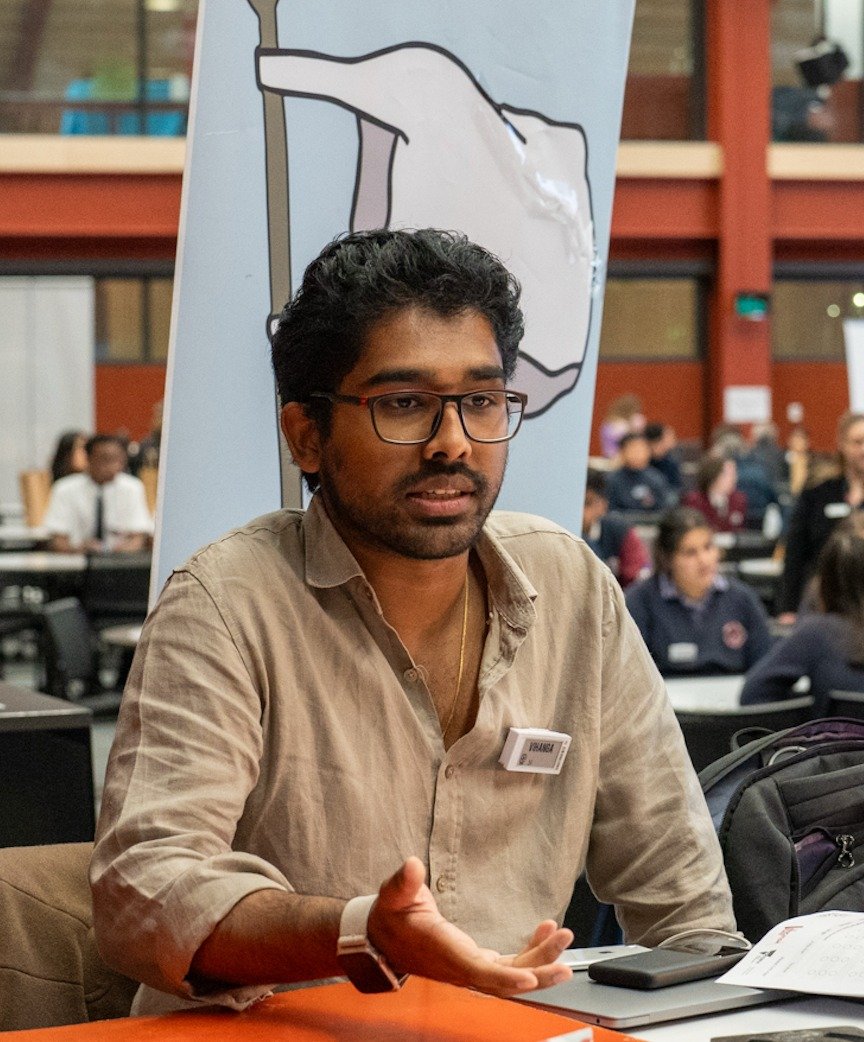
Vihanga sat this
interview himself.

He went through the JMSS application process as a student and came out of it with an offer. He also spent years in competitive public speaking — including two first-place finishes against Year 12 students while still in the middle years — which is where most of the communication material in this weekend originally comes from.

Since then he has taught more than 1,400 students across over 4,000 hours, run workshops and speeches at more than fifteen schools and institutions, and worked as a consultant with some of Victoria's most prominent tutoring companies on curriculum and student outcomes.

The interview is the one stage of the JMSS process where almost no structured preparation exists. After watching students walk into it unprepared, the gap seemed both unnecessary and closable — which is why this exists in free form on the channel, and in this longer form over a weekend.

Vihanga, founder of Clarity Coaching
JMSS graduate — went through the same application and interview process as a student.
4,000+ teaching hours across 1,400+ students in VCE Maths, Science, English and selective entry preparation.
15+ workshops and speeches delivered for schools, institutions and leading Victorian tutoring companies.
Competitive public speaking background — first against Year 12 competitors, twice, as a middle-years student.
Enrolment

One price.
Everything included.

Nine hours live, Q&A in every session, and every recording kept through to interview day. Nothing is held back and nothing is sold separately.

$349
One payment, AUD, GST included.
Enrolment stays open until the final session begins on Sunday 9 August. Join after a session has run and you get that recording immediately.

JMSS Interview Intensive
7–9 August 2026

Enrol now
Joining link and intake form sent immediately after enrolment.
  • All three live sessions — nine hours on Zoom, breaks included
  • Every session recorded, kept until interview day
  • Dedicated Q&A in each of the three sessions
  • Send your achievement list, draft answers, or questions in beforehand
  • Live answer breakdowns and drills you can keep using afterwards
  • No camera required at any point

What's promised, and what isn't.

What this is. A large-format live workshop, not one-to-one coaching. Individual attention is not guaranteed and shouldn't be assumed. There is no separate workbook or booklet — the material is the live teaching, the drills, and the recordings you keep.

On outcomes. No offer is guaranteed. Selection is the school's decision and depends on factors no external program controls. What is promised is delivery: nine hours of live teaching, Q&A in every session, and every recording.

On refunds. Enrolments are non-refundable. Delivery is concentrated into a single weekend and places are committed the moment you enrol, so please read this page carefully and email any questions before paying rather than after. This does not affect your rights under Australian Consumer Law.

Before you enrol

The questions worth
asking first.

If something isn't covered here, email before you enrol rather than after. An awkward question answered early is better than a family ending up in the wrong room.

Do you know what questions JMSS will ask?
No, and neither does anyone else offering interview preparation. The school doesn't publish the format or the rubric, and accounts from past cohorts describe different structures in different years. The teaching is on underlying interview skill rather than a predicted question list — which is the honest version, and also the version that survives a format change.
How is this different from the free videos on YouTube?

The free content covers the frameworks properly and isn't a teaser. What it can't do is respond to your child's specific achievement list, tell them when an answer sounds recited, or put them in a room where other students are being corrected in real time.

There's a second, blunter difference. A paid cohort filters for students who intend to do the work, and since the method is about building your own answers rather than copying a model one, who's in the room affects what everyone gets out of it. If your child wants a script to memorise, the videos will serve them better and cost nothing.

Our interview is on the 12th. Is three nights enough time?

Yes. In one-to-one work the usual recommendation is three sessions of about an hour, and students consistently come out of that with markedly better confidence and performance. This is roughly three times that amount of contact, going through the same material in more depth.

The other half of the answer is what happens afterwards. The drills are built to be done alone, anywhere, with nothing but a phone — so the days between Sunday and your interview are working time, not waiting time.

Will you train for the group task?

Not directly, and it's worth being clear about why. Running mock group tasks with meaningful feedback isn't possible in a large Zoom workshop, and a version done badly would be worse than not doing it.

What is covered is the psychology and the strategy — how to be genuinely useful to a group while still being visible in it, and how to handle the moments where those two things pull against each other. Whether a group task appears at all this year is unknown, and past years are not a promise about this one.

Will my child get individual attention?
Not guaranteed. This is a large-format live session and there will be more students than can be worked with individually in nine hours. Everyone gets Q&A in every session and everyone can send questions and submissions in beforehand, but if what you want is guaranteed one-to-one time, this isn't the right product and private coaching is the honest answer.
My child is quiet and hates speaking in front of people.

They're often the students who gain the most. No camera is needed and nobody is required to speak — students can take part entirely through chat, and typed answers get worked through the same way spoken ones do.

Students do get picked out to answer live, and it's strongly encouraged, because that's where the fastest growth is. But anyone can pass without comment, and the intake form asks in advance whether your child would rather volunteer than be called on. That preference is respected.

What if we can't make one of the sessions?
Every session is recorded start to finish and uploaded the same day, so a missed night can be caught up before the next one. The live sessions are better because questions get answered in the room, but nothing is lost if there's a clash.
Can we still enrol once the weekend has started?
Yes, up until the final session begins on Sunday morning. Any session that has already run is available as a recording immediately, so you can catch up before joining the next one live.
Do you guarantee an offer?
No. Selection is the school's decision and no external program controls it. What is guaranteed is the delivery: nine hours of live teaching, Q&A in every session, and every recording, described accurately on this page.
JMSS Interview Intensive 2026

Friday, Saturday, Sunday.
Then the days that are
yours to use.

7–9 August, live on Zoom, fully recorded. The invitation has already come. This is one way to spend the weekend before the interview, and the free material on the channel is another — either is a defensible choice.